For decades, organizations have been built around a simple and deeply ingrained principle:
Humans make decisions. Systems execute.
This model has shaped management thinking, organizational design, and even leadership culture.
Managers sit at the center of the organization:
- collecting information
- interpreting data
- making decisions
- coordinating execution
But this model was designed for a different era — an era where:
- data was scarce
- information moved slowly
- decisions could afford to be delayed
Today, none of these assumptions hold true.
Data is continuous.
Operations are real-time.
Complexity has exploded.
And most importantly:
the speed of reality has outpaced the speed of human-centered decision-making
This is where a new model begins to emerge:
👉 Autonomous Organization
The Breaking Point of Traditional Management

Traditional organizations are reaching their operational limits.
Not because managers are incapable,
but because the system they operate within is no longer sufficient.
Three structural constraints define this limitation:
1. Information Bottlenecks
In most organizations, data still flows through layers:
- frontline → middle management → leadership
At each layer:
- information is filtered
- context is lost
- time is delayed
By the time a decision is made:
👉 the situation has already changed
2. Human-Centric Decision Load
Managers are expected to:
- monitor operations
- analyze issues
- prioritize actions
- make decisions
But as operations scale:
👉 the number of decisions grows exponentially
This creates:
- decision fatigue
- inconsistent judgment
- delayed responses
3. Fragmented Execution Visibility
Even with modern dashboards, most organizations still lack:
👉 true visibility into execution
They see:
- results
- summaries
- reports
But they do not see:
- what is happening right now
- where work is getting stuck
- how execution is actually unfolding
Decision Infrastructure: The Next Competitive Advantage for Modern Organizations
Defining the Autonomous Organization

An Autonomous Organization is not a company without humans.
It is a company where:
systems are capable of continuously sensing, interpreting, and responding to operational realities — with minimal manual intervention
This capability is built on three characteristics:
1. Continuous Awareness
The organization is always “aware” of what is happening through:
👉 Execution Data
Not reports.
Not summaries.
But real-time signals from actual work.
2. System-Driven Response
Instead of waiting for human intervention:
- issues are detected automatically
- patterns are identified
- actions are suggested (or triggered)
3. Human Oversight, Not Dependency
Humans remain critical, but their role shifts:
- from reacting → to designing
- from controlling → to guiding
The Three Foundational Layers

An Autonomous Organization does not emerge from AI alone.
It is built on the integration of three foundational layers:
1. Execution Data — The Sensory System
Execution Data represents:
👉 the real-time footprint of work being done
It includes:
- task progress
- on-site activities
- resource utilization
- deviations and delays
Without Execution Data:
👉 the organization is effectively blind
2. Decision Infrastructure — The Nervous System
Decision Infrastructure transforms data into action.
It defines:
- how signals are interpreted
- how decisions are triggered
- how workflows respond
It connects:
👉 data → logic → action
3. AI Layer — The Cognitive System
AI adds intelligence to the system:
- detecting patterns
- predicting outcomes
- recommending decisions
But AI alone is not enough.
Without data and structure:
👉 AI becomes noise, not intelligence
From Command-Based to System-Driven Organizations

Traditional organizations operate on:
👉 command chains
Instructions flow downward.
Reports flow upward.
Autonomous Organizations operate on:
👉 feedback loops
- data flows continuously
- systems respond dynamically
- actions are adjusted in real time
This shift is fundamental:
from hierarchy → to system dynamics
Redefining the Role of Management

As systems take over operational coordination,
the role of managers must evolve.
Managers are no longer:
- coordinators of tasks
- collectors of reports
- reactive problem-solvers
They become:
1. System Designers
They define:
- workflows
- rules
- decision logic
2. Organizational Architects
They shape:
- how teams interact
- how information flows
- how decisions are distributed
3. Performance Optimizers
They continuously improve:
- system efficiency
- response accuracy
- execution quality
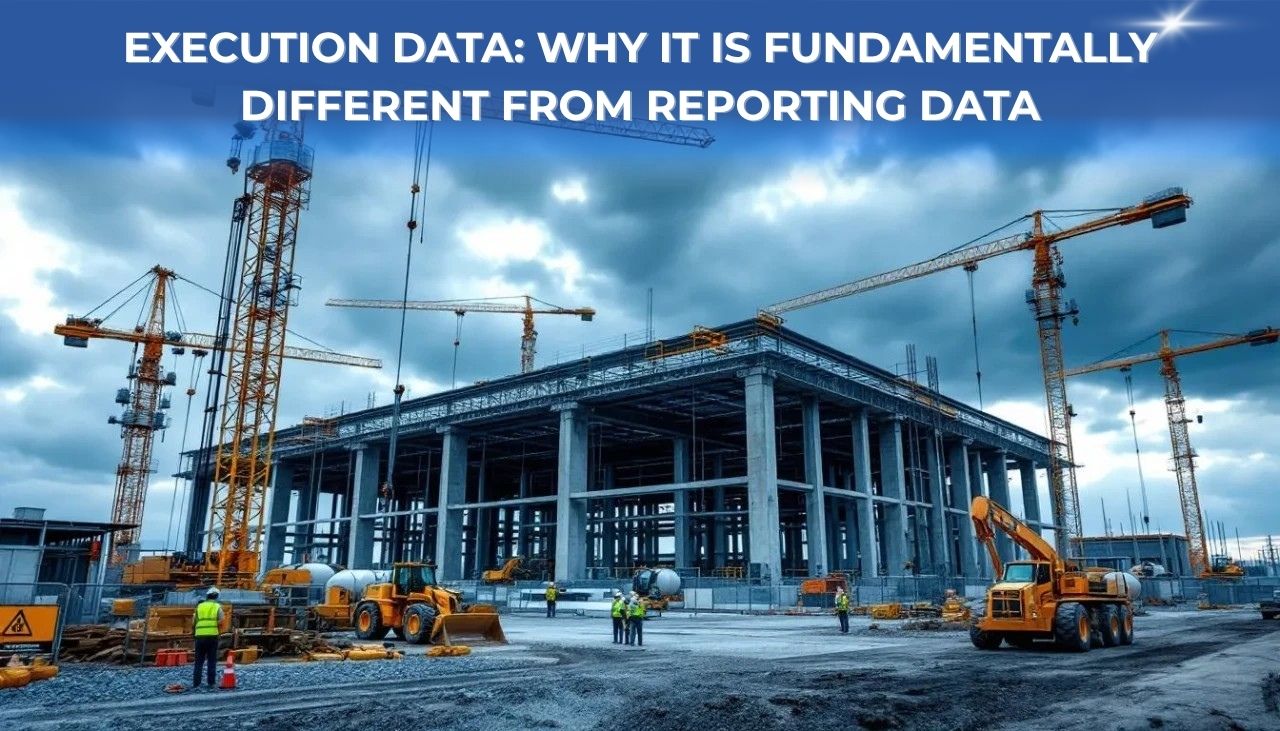
Autonomous Organization in Construction
Few industries benefit more from autonomy than construction.
Construction projects are:
- highly fragmented
- multi-layered
- time-sensitive
- risk-intensive
In traditional models:
- delays are discovered late
- cost overruns accumulate silently
- coordination depends on meetings
With an Autonomous Organization model:
Real-time visibility
- site activities are continuously tracked
Early detection
- delays and risks are identified immediately
Data-linked cost control
- spending is tied directly to execution
Continuous coordination
- workflows adjust dynamically
Automation vs Autonomy — A Critical Distinction
Many organizations believe they are progressing
simply because they are automating processes.
But automation is not autonomy.
Automation:
- rule-based
- task-specific
- static
Autonomy:
- adaptive
- system-wide
- data-driven
Automation improves efficiency.
Autonomy transforms the organization.
The New Competitive Advantage
In the past, competitive advantage came from:
- capital
- scale
- workforce
Today, it increasingly comes from:
👉 system intelligence
The ability to:
- sense reality
- interpret signals
- respond in real time
Organizations that achieve this will:
- move faster
- adapt better
- operate with less friction
When the System Starts Running the Organization
At a certain point, a qualitative shift occurs.
The organization no longer depends on:
👉 “who is available to decide”
Instead:
- systems handle routine decisions
- humans focus on strategic direction
- execution becomes continuous
This is not automation.
This is:
👉 operational autonomy
Conclusion
Autonomous Organizations are not a distant future concept.
They are already emerging — wherever:
- execution data is captured
- decision infrastructure is defined
- AI is meaningfully applied
This is not about replacing humans.
It is about redefining their role.
From operators of systems
to designers of systems
And in doing so, organizations unlock something fundamentally new:
👉 the ability to operate in real time, at scale, with intelligence
Đỗ Hữu Binh
CEO, ISOFT
This article is part of a professional series analyzing construction project management and cost control strategies.
© 2026 Đỗ Hữu Binh. All rights reserved.
Any citation or reuse of this content must clearly state the source and author.