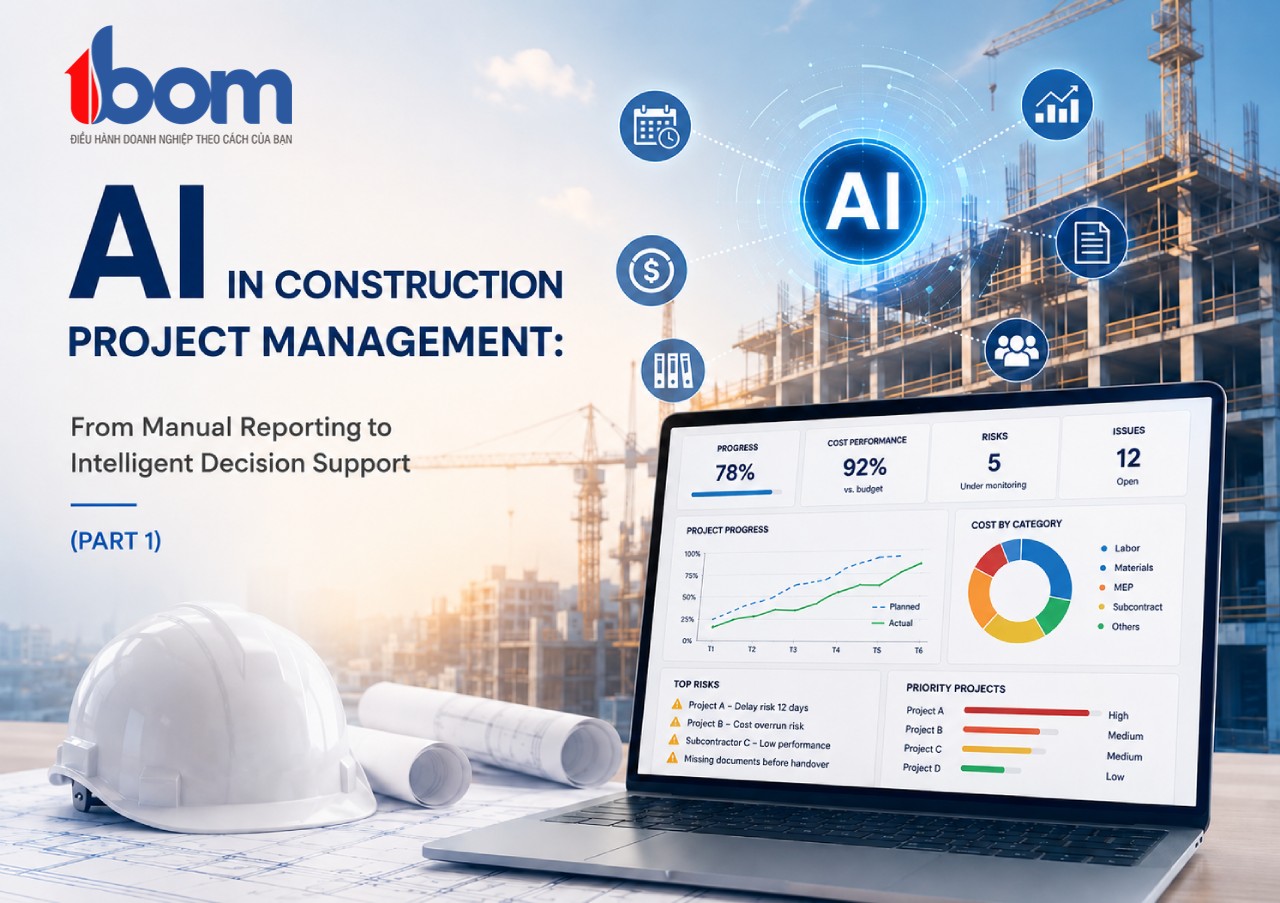
How AI Can Be Applied in Construction Project Management

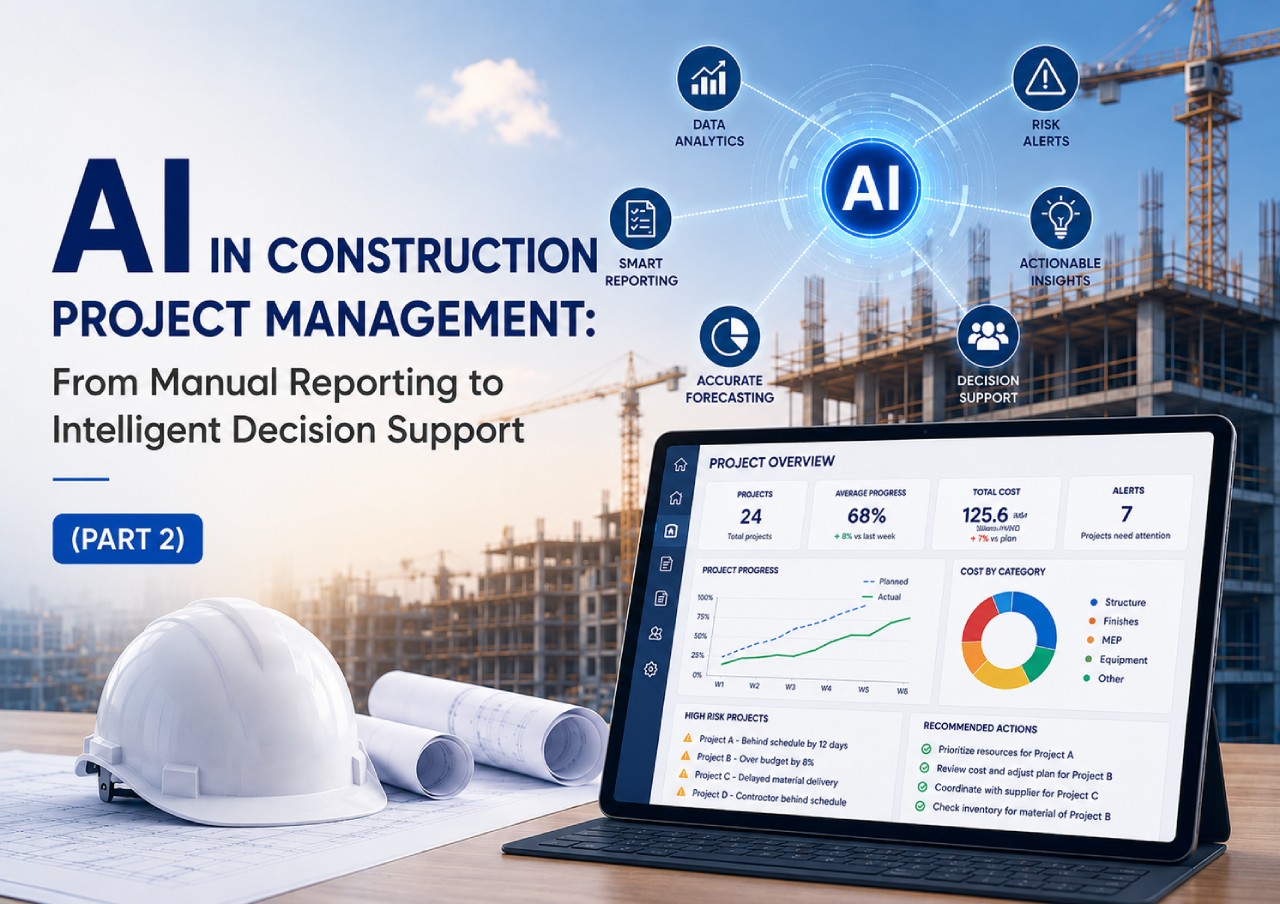
AI in construction is not a single feature. It can be applied across multiple layers of project execution.
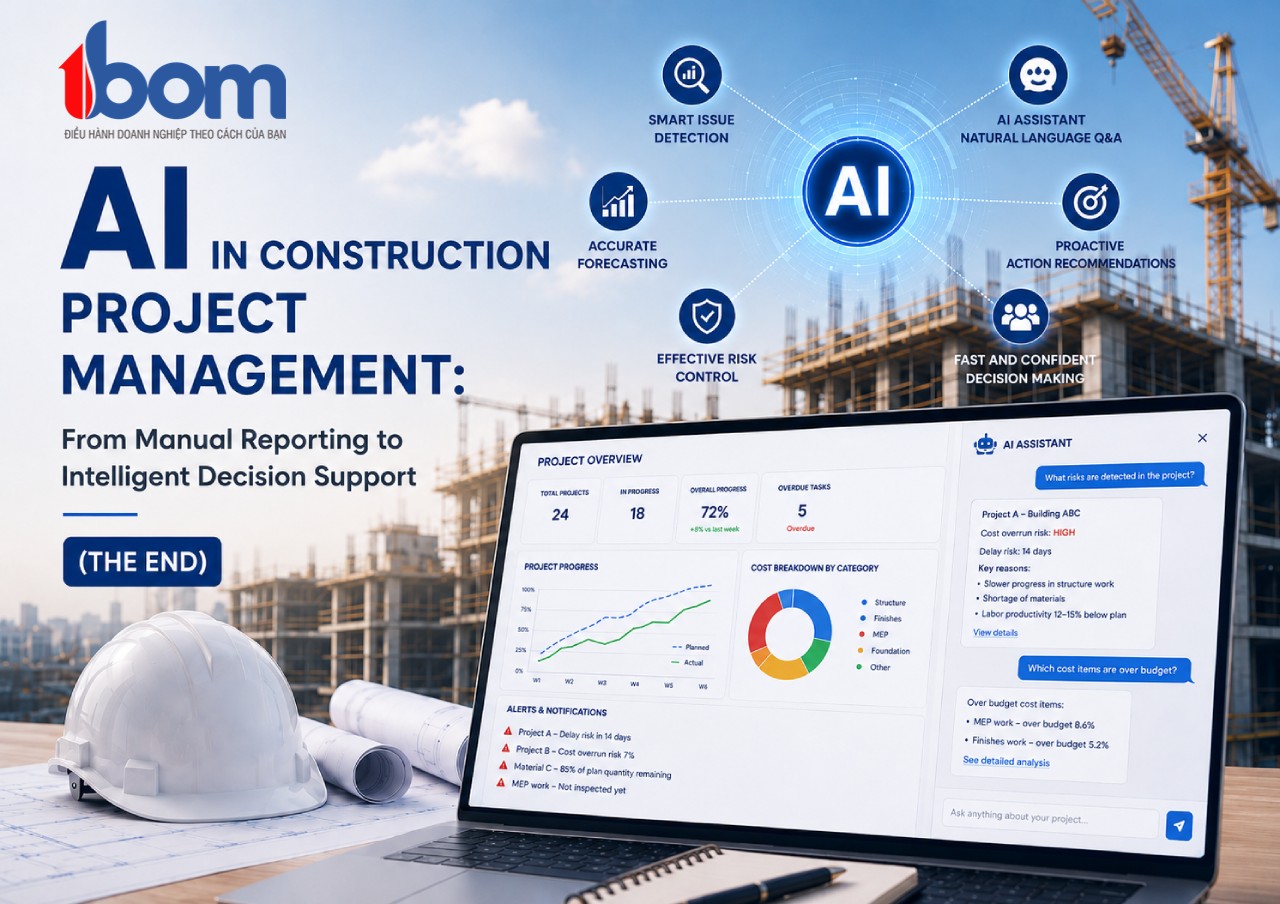
1. AI for Project Data Q&A
This is one of the most practical applications.
Instead of manually filtering data, users can ask the system in natural language:
- “Which project is most delayed?”
- “Which work package is over budget?”
- “How has the BOQ for foundation work changed compared to plan?”
- “Which subcontractor has the lowest performance this month?”
- “Which acceptance documents are missing?”
- “Which tasks are overdue?”
- “How did project A perform this week compared to last week?”
If the system is connected to real project data, AI can answer based on actual project information.
This reduces the time required to find and interpret data.
Execution Infrastructure — The Missing Foundation of Modern Enterprise Execution
2. AI for Schedule Risk Detection
AI can analyze schedule data to identify early risk signals:
- Work items repeatedly delayed
- Productivity decreasing over time
- Subcontractors failing to meet planned output
- Dependent tasks affecting each other
- Milestones likely to be delayed
For EPC contractors and general contractors, schedule risks often have a chain effect.
A delay in engineering may delay procurement. A procurement delay may delay construction. A construction delay may affect commissioning and handover.
AI can help detect these dependencies earlier.
3. AI for Cost Control
AI can analyze project cost from multiple dimensions:
- By project
- By work package
- By subcontractor
- By time period
- By cost category
- By quantity completed
From there, AI can detect:
- Abnormal cost increases
- Work packages at risk of budget overrun
- Uncontrolled variations
- Gaps between quantity and payment
- Subcontractors with high variation rates
This helps companies understand project profitability earlier instead of waiting until the end of the project.
AI & Power: Whoever Controls the Algorithm Controls the Advantage
4. AI for BOQ and Quantity Management
BOQ is one of the most valuable data layers for AI in construction.
AI can support:
- Detecting BOQ deviations
- Comparing planned and actual quantities
- Identifying variation items
- Analyzing accepted quantities
- Tracking quantity changes over time
- Highlighting items that need review
This is especially important for general contractors and EPC companies, where even small quantity deviations can affect cost and profit.
5. AI for Subcontractor Performance Management
Subcontractors directly affect schedule, quality, and cost.
AI can help evaluate subcontractor performance based on real data:
- On-time completion rate
- Completed quantities
- Number of issues
- Acceptance pass rate
- Delay frequency
- Variation cost ratio
- Impact on related work packages
With enough data, companies can build a more transparent and objective subcontractor performance management system.
6. AI for Document Management
Construction projects generate a large volume of documents:
- Drawings
- Contracts
- Appendices
- Acceptance records
- Site diaries
- Quality documents
- Payment files
- Legal documents
- Approval documents
- Communication records
AI can help users search and retrieve project information faster.
For example:
- “Are the acceptance documents for Level 5 complete?”
- “Which is the latest drawing revision for Zone B?”
- “Does the MEP subcontract contain a delay penalty clause?”
- “Which documents relate to quantity variation this month?”
When document data is digitized and properly permissioned, AI can become a powerful project information assistant.
7. AI for Automated Reporting
Reporting is one of the most time-consuming activities in construction companies.
AI can help generate draft reports based on available data:
- Weekly progress reports
- Cost reports
- Risk reports
- Subcontractor reports
- Executive dashboards
- Work packages requiring attention
- BOQ variation summaries
Instead of spending hours consolidating data manually, teams can use AI-generated drafts and review them before submission.
This saves time and improves reporting consistency across the organization.
AI Does Not Replace Project Managers

A common misunderstanding is that AI will replace project managers.
In construction, this is not realistic.
AI cannot fully replace human experience, site coordination skills, contractual judgment, stakeholder management, or executive responsibility.
AI is better understood as:
- A data assistant
- A risk assistant
- A reporting assistant
- An analysis assistant
- A decision-support assistant
The project manager remains responsible for final decisions.
AI helps project managers work with better data, identify issues faster, and make more informed decisions.
In short:
AI does not replace project managers. AI makes project managers more effective.
What Construction Companies Need Before Applying AI
Not every AI implementation creates value.
To make AI useful, construction companies need several foundations.
1. Data Must Be Digitized
AI cannot analyze data that only exists in paper files, fragmented spreadsheets, or unstructured messages.
Companies need to digitize key project data such as:
- Schedule
- BOQ
- Quantity
- Cost
- Documents
- Subcontractors
- Tasks
- Acceptance records
- Site reports
2. Data Must Be Standardized
Digitization is not enough.
Data must also be standardized.
For example:
- Each project should have a consistent project code
- Each subcontractor should have a consistent vendor code
- BOQ should have a clear structure
- Schedule should be linked to work packages
- Cost should be categorized correctly
- Documents should be linked to relevant projects and work items
Without standardized data, AI outputs may be inconsistent or unreliable.
3. Data Must Be Updated Frequently
AI is only useful when input data is current.
If site teams update progress late, costs are entered late, and documents are not uploaded to the system, AI cannot reflect actual project status.
Companies need a strong habit of updating execution data regularly.
4. AI Must Be Integrated into Real Workflows
AI should not be a separate tool.
It should be integrated into real management workflows such as:
- Weekly meetings
- Executive reports
- Progress tracking
- Cost control
- Subcontractor management
- Acceptance management
- Risk monitoring
AI creates value when it becomes part of daily project operations.
5. Humans Must Remain in Control
AI can suggest, analyze, and alert.
But final decisions should remain with humans.
In construction, many decisions involve contracts, legal risks, safety, finance, and executive accountability.
AI should support decision-making, not replace it.
To be continued…
Đỗ Hữu Binh
CEO, ISOFT
This article is part of a professional series analyzing construction project management and cost control strategies.
© 2026 Đỗ Hữu Binh. All rights reserved.
Any citation or reuse of this content must clearly state the source and author.